
You can typically get Invisalign if you have crowns or veneers, as long as your dentist says they’re solid and properly bonded before you start treatment. This comes up a lot because so many adults considering clear aligners already have some dental work, maybe one old crown or a few veneers.
The tooth root and the bone around it still move the same way with aligners, since a crown or veneer only covers the outside. Below, we’ll explain what changes when you have crowns or veneers, and what happens at your first visit.
The Short Answer: In Most Cases, Yes
In most cases, you can still do Invisalign with crowns or veneers, because the biological process that moves a tooth happens under the surface, at the root and periodontal ligament, not at the crown or veneer sitting on top. Align Technology, the company behind Invisalign, says its SmartForce attachments are designed to grip teeth precisely, even if you already have dental work.
The American Association of Orthodontists says around 1 in 4 people wearing braces now are adults. And most adults already have some kind of dental work. So for orthodontists, crowns and veneers are not some rare thing; they deal with them every single day.
How Crowns and Veneers Affect an Invisalign Treatment Plan
Three things matter in an Invisalign treatment plan: where the crown or veneer is in your mouth, how strongly it’s bonded to the tooth, and how much that tooth needs to move.
Location of the restoration
If the crown or veneer is on a front tooth that only needs to move a little, it is not a big deal. It gets more tricky when a tooth needs to turn a lot or move a long way, because that puts more pressure right on the restoration. Your orthodontist will figure out which teeth have to do the heavy lifting, and if they can, they will place the attachments so there is less stress on the teeth with crowns or veneers.
Condition and bonding strength
A new crown that is bonded tightly is different from an old one that is already loose. When the bond is weak, the pressure from aligners can actually pop it loose. So, your dentist will check its strength before you even start. If it feels shaky, they will fix it or replace it first so you don’t run into trouble in the middle of treatment.
Whether the restored tooth needs to move
If a tooth with a crown or veneer only needs a small nudge, it is easy to plan around. If it needs to rotate a lot or move far, then you need stronger attachments and a closer eye on it. When that kind of big move is needed, the orthodontist will often let the natural teeth next to it do more of the work so there is less strain on the restored one.
Can Invisalign Actually Move a Crowned Tooth?
Yes, Invisalign can move a tooth even if it has a crown.
Keep in mind, a crown is just a cap that goes over your real tooth, not a new root. Your root and the bone around it are still there, still alive, still the same as before. So when the aligner puts light pressure on it, the bone and root react just like a natural tooth would.
Nothing changes biologically. The only difference is in grip. You know those little tooth-colored dots they put on to hold the trays? They don’t stick to smooth, shiny porcelain the way they do to regular enamel. So you can call it a bonding problem, not the tooth movement in the bone.
Invisalign vs Traditional Braces When You Have Crowns
Invisalign is much lighter on crowns and veneers than regular braces. With clear aligners, nothing gets glued right on the restoration. No metal bracket sits on your crown. So do not worry about a bracket popping your crown off or chipping your veneer. Traditional braces still work for restorations, but their brackets and wires put nonstop pressure on them.
Invisalign with Crowns/Veneers | Traditional Braces with Crowns/Veneers |
| No brackets glued to the restoration | Brackets bonded directly onto teeth, including crowns |
| Attachments placed carefully around weak spots | Wires apply constant, direct pressure |
| Lower risk of chipping a veneer’s surface | Small risk of bracket loosening a crown |
| Removable for cleaning around restorations | Fixed in place for the full treatment |
What Your Orthodontist Checks Before Approving Treatment
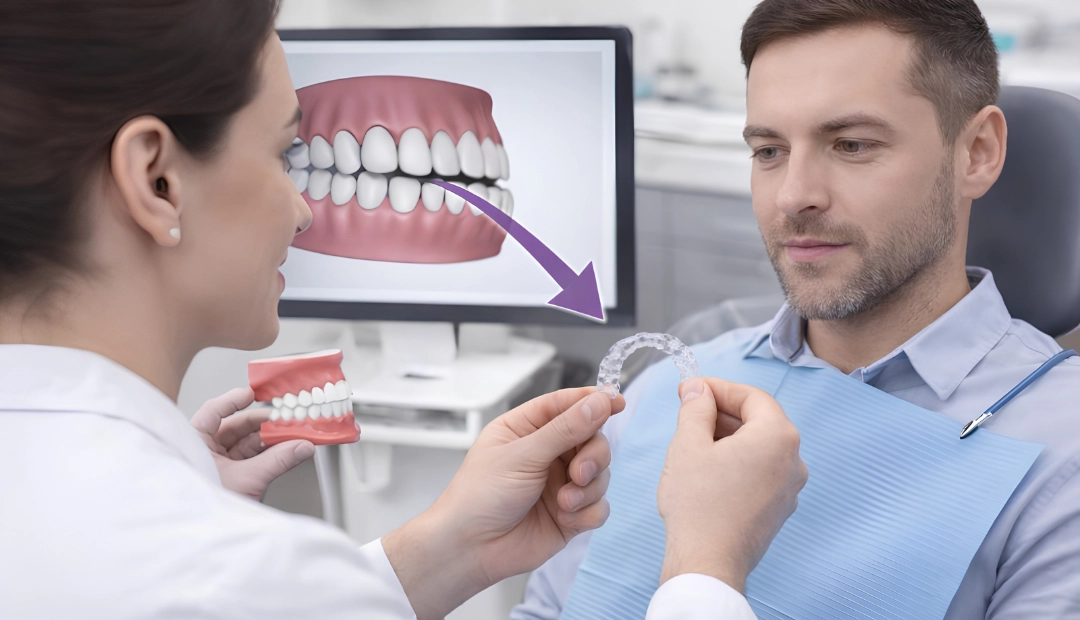
Before you start Invisalign, your orthodontist will look closely at every crown and veneer you have. How healthy is it? How does it fit? Is it still bonded tightly? The answer to all these questions is possible with digital scans and X-rays. They clearly show the root and the bone underneath.
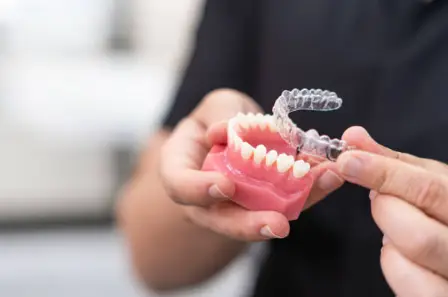
After that, they also check how far each restored tooth actually has to move. A small shift is easy to plan for. A big rotation takes more work. And if any crown or veneer looks worn, cracked, or a bit loose, your dentist will fix that first before your aligners are ever made.
What If Invisalign Isn’t a Good Fit for My Crowns?
If Invisalign is not a great match for your crowns, you still have options to get a straighter smile. Your orthodontist can suggest traditional metal braces, clear ceramic braces, etc. They can also design a custom aligner plan that just skips attachments on the weaker restorations.
One exception is a dental bridge. It connects a few teeth, so it can’t move on its own. No aligner can move a bridge. If you have one, your dentist will usually work around it or plan to replace it once your other teeth are straight.
Frequently Asked Questions
Will Invisalign damage my veneers?
Usually not. When your attachments are placed and removed properly, Invisalign rarely damages veneers. Most orthodontists actually avoid putting an attachment directly on a veneer just to keep it safe.
Can a crowned tooth actually move with clear aligners?
Yes, it can. A crowned tooth moves just like a normal tooth because it is the root and the bone that do the moving, not the crown on top.
Do I need to replace my crowns after Invisalign treatment?
Most people don’t. But if your bite shifts or your teeth end up in a totally different place, your dentist will recommend updating a crown. Because it blends in better with the teeth around it.
Is it more expensive to get Invisalign with crowns?
No, it’s not. A crown or veneer doesn’t automatically increase the price. If your case is more complex and needs extra planning or special attachments, you will definitely pay more.
What if I only have one crown; does that rule out Invisalign?
Not at all. One crown is usually no problem, especially if it is old and still solid. Your orthodontist will just plan the attachments and the movement around that tooth.
Final Thoughts
In most cases, you can absolutely get Invisalign even if you have crowns or veneers. The tooth moves because of the root and the bone underneath, not because of what’s on top. What matters is where the crown or veneer is, its condition, how strong the bond is, and how much the tooth needs to move.
At Dietrich & Kelso Orthodontics, orthodontists fully check your dental history on day one – crowns, veneers, bridges, everything. They make a plan that protects the work you already have while still straightening your smile. If you have crowns or veneers and are wondering if Invisalign will work for you, schedule a consultation with Dietrich & Kelso Orthodontics to get a straight answer.

Dietrich & Kelso Orthodontics
Dietrich & Kelso Orthodontics provides advanced orthodontic care with Invisalign and ceramic braces to help patients achieve healthy, confident smiles. We specialize in modern teeth straightening solutions for kids, teens, and adults, with a focus on comfort, precision, and long-lasting results.
Book a Free Consult